

-
COMMUNITY OF MICROBES
Multiple species of bacteria and fungi living together.²
-
ENTANGLED POLYMERS
Microbes secrete a protective matrix called EPS (extracellular polymeric substance) made from polymers including proteins, glycolipids, polysaccharides and DNA.¹,²
-
METAL IONS
Metal ions link polymers of the EPS, forming a resilient barrier.
Biofilm attaches to both living surfaces (e.g., wounds, mucosal tissue) and non-living surfaces (e.g., implants, surgical hardware, catheters).²
Clinical Significance
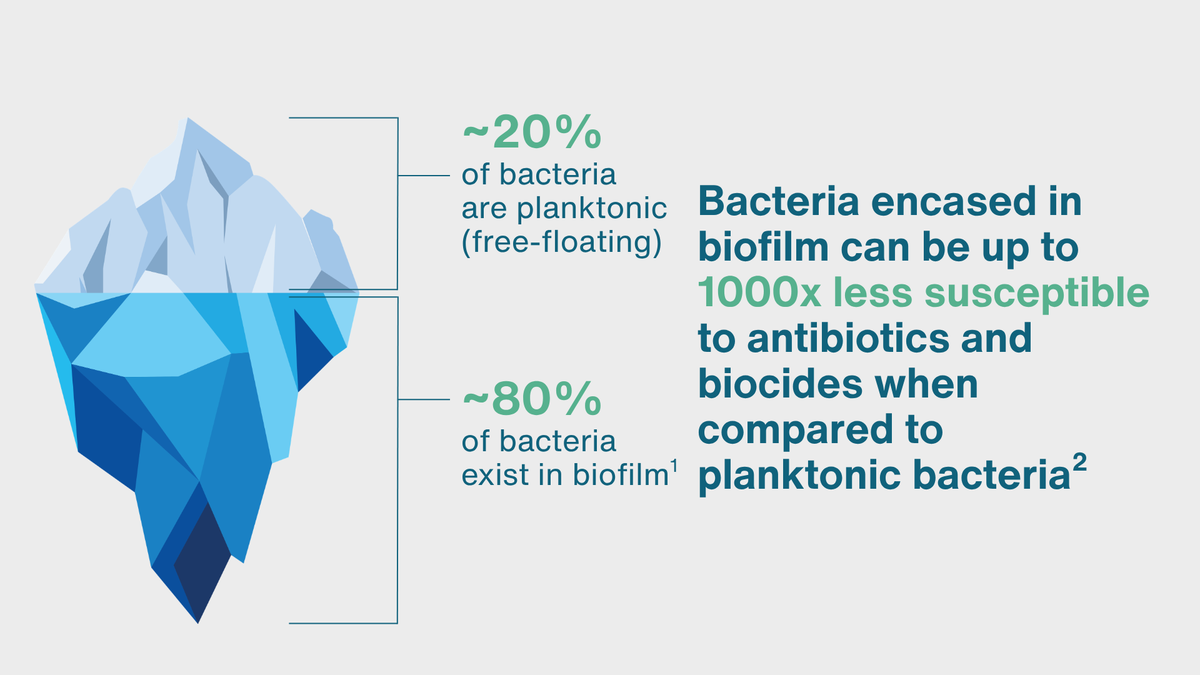
Biofilm is considered the dominant mode of microbial growth. It is estimated that approximately 80% of bacteria exist within biofilm communities, with the remaining 20% in a free-floating (planktonic) state.¹
This structure makes biofilm-embedded bacteria significantly harder to treat² than the free-floating bacteria, for several reasons:
The EPS matrix physically blocks antibiotics and antiseptics.¹
The protective layer restricts how far these agents can penetrate, so bacteria deep within the biofilm may never be exposed to a therapeutic dose.
The immune system struggles to reach them.²
Immune cells that would normally identify and clear bacteria have limited access to organisms sheltered within the matrix.
Some bacteria "switch off."¹,²
A portion of the bacteria within a biofilm become dormant, or metabolically inactive. Most antibiotics work by targeting actively growing and dividing cells, so dormant bacteria are largely unaffected by treatment - and can reactivate later.
Bacteria can share resistance with each other.²
Within a biofilm, bacteria are able to exchange genetic material, including genes for antibiotic resistance, making the community as a whole more resilient over time.
Biofilm also presents a diagnostic challenge
Routine culturing techniques often struggle to detect biofilm-based bacteria.
In one study of infected hip and knee replacements, standard culture failed to identify any bacteria in nearly half of the confirmed infections. When researchers applied a more sensitive genetic testing method to those same culture-negative cases, it detected a pathogen culture had missed in over 40% of them.³
This has direct implications for how infection is identified, managed and prevented.
Approaches to Biofilm
The EPS matrix relies in part on metal ions to hold its structure together. One concept is to target those ion bonds, loosening the matrix so microorganisms can be removed more readily.
Conceptually, this can be described in three stages:
-
Deconstruction
Loosening the EPS structure, for example by binding the metal ions that link its polymer strands.
-
Dislodgement
Once the matrix is loosened, microorganisms and debris can be more readily dislodged and flushed from the wound.
-
Defence
Biofilm can re-emerge within days of debridement,² which is why limiting recolonisation matters.
This three-part principle underlies surgical irrigation technologies such as XPERIENCE® Advanced Surgical Irrigation, part of the range Novus Surgical supplies in support of infection-prevention protocols.
Collapsible content
Disclaimers
ALWAYS READ THE LABEL AND FOLLOW THE INSTRUCTIONS FOR USE.
XPERIENCE is intended for use by healthcare professionals only. Full technical, clinical and safety documentation, including its ARTG entry and Instructions for Use, is available via the Resources page or through a Novus Surgical representative.
This page provides general scientific information regarding biofilm and is not intended as medical advice. It does not constitute a recommendation for the diagnosis, treatment or management of any condition. Clinical decisions regarding infection prevention should be made in consultation with a qualified healthcare professional.
References
- Penesyan A, et al. Three faces of biofilms: a microbial lifestyle, a nascent multicellular organism, and an incubator for diversity. NPJ Biofilms Microbiomes. 2021;7(1):80.
- Omar A, et al. Microbial Biofilms and Chronic Wounds. Microorganisms. 2017;5(1):9.
- Thoendel MJ, et al. Identification of Prosthetic Joint Infection Pathogens Using a Shotgun Metagenomics Approach. Clin Infect Dis. 2018;67(9):1333-1338.